Showing posts with label Time Management. Show all posts

60 Second Rule

The 60 second rule (also known as the 1 minute rule) is a simple concept that helps you stay on top of all those minor jobs/tasks that you don't get round to.
The 60 second rule is that for every job/task that you see needs doing, if it takes 60 seconds (1 minute) or less then you need to do it. No ifs, no buts, you just have to get on and do it as it's only 60 seconds or less. Some people are really quite pushed for time during their day and have hardly any time to spare, but the great thing about this is that everyone can spare an extra minute putting something in its right place, which is why this rule is so useful because everyone can do it. Some of you may be saying, "no, actually I don't have that time". Well my response would be yes you do. If you were to look at it like; If you leave the house 1 minute later is it going to make a huge impact on your day? Or, if you were to go to bed 1 minute later would that affect your sleeping pattern? When you ask questions like this, it makes you realise that actually 1 more minute isn't going to kill you.

I don't know about you, but for me I really hate to have small jobs/tasks laying around to be completed, especially those that have been put off. They just feel like they're nagging on me for the whole day (or for however long it is left) and over time build up until there are many more nagging jobs for me to complete. Normally its because of the fact that I say to myself "I'll do it later" or "I'm busy at the moment so I can't do it now". These aren't really that great of excuses to stop me from doing them right away and I know that 60 seconds won't make a difference to my day, so I might as well do it.

It is a concept that I have only recently started to use, I would say during the last 2 weeks, and it has definitely helped me to take care of those small annoying jobs. I am someone who likes a tidy and organised space. I'm not too concerned with throwing things out and am fine living in a minimalist home. My family on the other hand, whilst they also like a tidy home, are not one for being minimalist, and even though I said that they like a tidy home - there are often things left out or in the wrong places - Discs always seem to be one of these, so for me there is never a day I can't put the 60 second rule to use.

Whenever I have heard someone speak about this concept or have read something about it, it is always in reference to tidying and de-cluttering. I can understand why as it is an extremely useful rule for helping to stay on top of things, however, I don't think it should be solely used for tidying and de-cluttering. I think that for any job or task that needs doing with an estimated time of a minute or less should be done too. Why limit it to tidying?

For anyone who hasn't tried the 60 second rule or hasn't heard about it before reading this post, and has trouble motivating themselves to do these small jobs, I encourage to try this out.

Things-to-do-Today List

Basically, the things-to-do-today list is exactly what the name implies - a list of things that need to be done during the day. It is a guide for you to follow.
For me personally, if I am going to be as productive as I would like to be then I need to have a daily schedule/list consisting of exactly what needs to be done. Even if I know what needs to be done during my day, I find myself procrastinating if I don't write myself a detailed list with imposed restrictions. I found however, when looking into this, that this is true for many other people, that they aren't as likely to get everything done in the day without the help of a list/schedule, even when they know what they should be doing.

The great thing about having a list of things to do gives your day purpose and keeps you busy. Even if you feel your day has purpose without a plan, having it all laid out in front of you, I find at least, to be comforting because you know exactly what you are doing and where you would like to get to.
I absolutely hate the feeling of a wasted day. If I haven't done what I have needed to get done during the course of the day, then to me that is a day wasted - a feeling that I can't stand. To be honest, a problem I have is that if I'm not productive or haven't done what I should have, then I will often feel quite down and disappointed with myself for allowing it to happen. This is the main reason why I started a daily schedule where I know exactly what I am doing at what time.

Your list/schedule can be made to be as simple or as complex as you would like to suit your needs. So if you are someone who just wants a list of things to do in no particular order then that's fine, or if you are someone who wants everything planned out to the smallest letter then that's also fine.
Things you may want to include:
  • Obviously a list of tasks/jobs that need doing (as this is the whole purpose of having a plan) :).
  • How long each task should last for.
  • What time they should be carried out.
  • What happens during each task. For example: If one of your tasks was to practice the guitar for an hour a day you could go into greater detail by writing what your practice should consist of. Another example could be to do 30 minutes cleaning your room. You could go into further detail by specifying what area(s) you will be focusing on.
Including time restrictions for certain jobs and placing a start and finish time on each thing on your list, you can then see how much of your day will be consumed, and gives you a better concept of time-management. You will become more and more familiar with how long things take to complete and at what times are best for specific tasks, making you more efficient. When I first started having a daily schedule I was surprised how what I needed to get done didn't consume the whole day as they previously had. Before I began using daily plans, I would waste a lot of time without realising between each task and that caused me to waste a lot of my day and finish what I needed to get done later than was necessary, if at all. Then when I started to use a daily schedule/plan I found that I could finish everything 3 or more hours earlier than I had been, which made a huge amount of difference.

I normally have three columns for three titles. The first column is for the jobs that need doing in the day, the second column is the time scheduled for each one, and the third column is for the small completion boxes that I tick once I have completed each task. For some jobs that I need to do but don't have a specific time set, I will mark with a asterisk, and they are to be completed when's best. For the vast majority of things though I will make sure that I schedule a time.

I like to get up early so I can have a good head start to the day. I can get all of my 'main' jobs completed by lunchtime, which is great. If I get up at 06:00, that gives me 6 hours, or 7 hours if I get up at 05:00, before lunch to get a main chunk of my schedule completed. I hate the feeling of having things hanging over me that I know need to be done, so by getting my main ones out of the way during the first half of the day feels brilliant.

I write my list/plan the night before. I have sometimes done it in the morning for the day, but to me the morning is when I am feeling most productive, if I spend that time writing my list of things to do for that day - I feel like it is a waste of time I could be using to get things done. In fact, I now include writing tomorrows list on today's schedule so I don't forget.

Whether it is a detailed minute-by-minute plan that you use or simply a very rough plan of what needs doing, having something there as a tool to improve your productivity is an excellent choice.
An old post of mine that you may enjoy is: 7 Benefits of a Schedule.

How to Plan Your Day

On average adults sleep for 7-8 hours a day and16-17 hours spent being awake. You would think that these 16-17 hours of being awake in the day would be enough time to get what you need to do done and sorted? Well for many of us this isn't the case and in fact is very easy for us to not get what we need to have done. Often we start with the intentions to get a lot of things done, but as the day passes us by and we keep delaying to do what needs doing, at the end of the day it feels as if we have wasted our time. It's having the self-discipline to go through with what needs doing and the sought after skill of being able to manage your time effectively that you will be able to produce productive days.
This is where a daily plan can be of use and of help to you to assist you with your daily-life, and is something that I would strongly recommend.

1. It may seem like a plan is a waste of time but it isn't.

It's no good deciding to make a plan if you think it's a rubbish idea and is a waste of time because you are more than likely not going to be able to properly commit to it and not be so strict upon yourself about sticking to it. If you are wanting to set-up a daily plan then make sure before you start it that you know the reasons why you want to have a plan and how it is going to benefit you - this will help to keep you focused upon sticking to your plan and following it through.

Having a daily plan will mean that you will never forget what needs doing, whether that's get some milk from the shop or to put the rubbish out, you won't forget as it will be laid out for you to see - so you will never have any need to remember what to do either.
You will also be able to sort through your tasks and decide which ones would be more effective to do at certain times and how they would be of better use of your time. Another thing is that you will often get through your daily jobs/chores/commitments etc a lot quicker than you usually would as you have everything laid out for you to see, you know exactly whats needs doing at any given moment.

2. Write your plan the night before

It's no good writing out a plan for your day on the day because you are using up valuable time when you could be being productive. There are people who do do this and can still make good use of there time, but creating a detailed plan taking 30 minutes or so is best done the night before. Evenings are also at the end of a day when more people have some a little extra free-time.
If you are not able to do it the evening before then do it at another part of your day when you are free, as long as it's the day before.

For me personally mornings are when I'm feeling the most productive and so I like to get up and get straight-on with the day and am not wanting to sit down and plan what I have to do for the day during my most productive time. Also if you start the day getting straight onto what needs doing chances are you will be more likely to continue as you are in that frame of mind to get things done.

3. Be strict about what you need to get done

Be strict with yourself about what needs to get done and write down all of the tasks that are a MUST for the day. These become your no.1 priority jobs to get completed. Next write down tasks that need to be done but aren't quite as important as your priority tasks.
Doing your priority tasks is of importance as they are things that you NEED to get done, other less important tasks that need to be done aren't as important to get done but are nice to see completed. Doing what you NEED to do and not what you want to do will lead to more productive days and you will be thankful for it.

4. Set mini plans for individual tasks

Once you have your plan set in place for the next day, try expanding upon it and going into more depth with each task, creating a sort of miniature plan for each one. This will mean staying productive and getting through each task will become all the more easier for you. 
An obvious example is with shopping - creating a shopping list. This will enable you to go through the store at a quicker rate and also helping you to not forget the things that you need to buy. 

Now I'll give you a personal example. I use my phone to help schedule my daily events and plans, on which I put most things. One of the things I put on is 'work' and also 'prepare for work'. I schedule in time to get myself ready for work and also have a further list which tells me exactly what I need to do. So for instance I have listed: get dressed for work, name badges, pen, bottle of water, wallet, etc. I do have more things listed on there that I do but it gives you an idea. I've seen an improvement to the time it takes me to get ready for work since following a list, allowing me to go from one thing to the next with ease and never forgetting to do anything. :)

5. Chunking

This is an effective technique that a lot of schedule-users like to implement as it allows you to make better use of your time. Chunking is where you group tasks into groups where you can then get them all out of the way at once. For example: You may need to go food shopping (with the help of your list) and you may also need to pick up your children from school which is near to the shops. So you could go food shopping and then pick up your children saving you from having to make two journeys. I also put shopping before picking the kids up as I know shopping with children can be a little stressful sometimes. :)
So have a look through your daily plan and see what you could chunk together to get out of the way on one clean swoop.

6. Plan larger tasks over a longer amount of time

Now you may have a large task on your plan that you know is going to take a lot longer to complete. It may be a task that will take over your day and prevent you from being able to complete your other tasks. Something you can do to make these larger tasks more manageable and still enable you to carry on with your other tasks is to split it into more manageable pieces, spread out over maybe a few days, or longer. You will have more energy for when you tackle the task each time and will be easier for you to stay motivated towards the task.  

Is T.V Wasting Your Time?

Often we wonder where all our free time goes to? one minute we seem to have some - the next it's gone. The first thing a lot of us say is that it's work that wastes so much of our time but that's something that we need to do and is something that society needs us to do - it's just part of our daily routine so can't be blamed for wasting our 'free time'. 

One thing that definitely does waste a lot of time would be t.v. Now when I say waste time I mean it's not anything that is productive or beneficial or outside or social, but is just something that causes you to sit and do nothing. Now I'm not saying that t.v isn't fun to watch or nice to have a sit down to but when you think about it - it does consume quite a lot of your life. 

For example: a quick calculation you could do would be to tally up how many minutes or hours of t.v you watch a day, let's say 1 hour which is fairly easy for most of us to accomplish during a day. Now if you watch t.v for 1 hour every day for a whole year that would be 365 hours of t.v watching. To put that into a bit more perspective that's the equivalent to watching t.v 24 hours a day for just over 15 days (just over 2 weeks)! 
That calculation was only with 1 hour of daily t.v watching. The average daily t.v viewing consumption time for British people is 3.5 hours!!! That's the equivalent to over 50 hours of t.v watching a year, which is equivalent to over 7.5 weeks of non-stop t.v watching!!!
Here's a really shocking figure, in the United States the average amount of time watching television daily is a whopping 8 hours!!!!! On average the only thing that consumes as much time or more is sleeping. If we did a calculation to 8 hours of t.v watching a day we could figure out that that would be the equivalent to watching 2,920 hours a year! 2,920 Hours a year is the equivalent of just over 17 weeks or 4 months of non-stop t.v watching! That is a huge waste of time. 1/3 Of the year in fact!

Think about one thing that you would want to do or want to get better at. Maybe that's improving reading ability, learning to play an instrument, exercising, blogging, whatever it is it would be time better spent. 1 Hour a day of that chosen activity would be (like stated above) the equivalent to doing over 2 weeks of that thing relentlessly a year.

Now there was a time in my life when I became a huge t.v watcher and at the start I really enjoyed it. But after a while I noticed that that was all I did and I didn't do anything else. So after a while of doing this and wasting a lot of my time, I managed to get a job and start doing other things rather than watching t.v - and now I don't really watch that much of it at all and can easily turn it off whilst in the middle of something.

A question to ask yourself is if you had a room with a sofa in but no t.v, would you go and sit down on that sofa for an hour or more every day and just do nothing? I'm guessing the answer for most of us would be no, and why? well because that would be a waste of our time as you're doing nothing...well that's essentially what t.v watching is too.

Now if you're reading this post you will probably be under the impression that I think that t.v isn't something that we should do, but actually I don't think there is anything wrong with watching t.v but it's how much you let it rule your life that I think is wrong. I watch t.v myself but I don't let it consume me to the point where I can't turn it off and I can quite happily turn it off and not watch it for extended periods of time, and it's this what I'm trying to get at.

Ask yourself how much your time do you spend watching t.v and if you can honestly go without it. A good experiment you can do would be to not watch t.v for 2 weeks, no exceptions. It may prove a lot harder than you first think.
If however you know you do watch a lot of t.v and you can't really go without watching it here's a previous post of mine: 8 Steps to Reduce T.V Watching.

    How to Become more Decisive

    "Using the power of decision gives you the capacity to get past any excuse to change any and every part of your life in an instant." 
    - Tony Robbins

    "It is in your moments of decision that your destiny is shaped." 
    - Tony Robbins

    "A real decision is measured by the fact that you've taken a new action. If there's no action, you haven't truly decided." 
    - Tony Robbins

    Life is essentially a big decision. We decide how we are going to live it and this shapes our future. No two lives are the same and it's these individual personal decisions that make up our life.
    On a daily basis we are faced with decisions, in fact everything we do, we have to decide to do in the first place. 

    Decisions are powerful things, and as pointed out by the quotes at the top of this post, they affect our whole lives. We can be on one course, and yet in an instant our whole lives can be changed because of a seemingly simple decision. 

    For example, lets pretend that you didn't live where you did at the moment, that before you moved to your house, you decided to move somewhere else. If you take a moment to think about that, you'll realise how much of your life would have been affected. You would probably have different friends, would've gone to different schools or workplaces, maybe your career would have been completely different, maybe you would have been better-off, maybe worse-off, your personality could have been different, etc. 
    It would have been from that one decision causing your whole life to have been changed, history rewritten in a sense. 

    Now that I've hopefully shown what big things decisions are, I'm going to share with you how you can become more decisive. Life can be overwhelming sometimes, and can be daunting. Making decisions can become tough, but you need to have the clarity to make the right decisions for your own life. It's time you became more decisive

    1. Every thing has an outcome

    Like I mentioned before, every single thing that happens in our life has an outcome. Decisions can greatly alter and affect the outcome, but indecisiveness can also be a factor. There will be an ending result as a cause to indecisiveness, so instead of not deciding, make the decision so you can do the best you can to alter a more favourable outcome. 

    2. Trust yourself

    Don't always be so hard and negative on yourself. If you believe that you're always going to make a bad decision, then you'll become indecisive. Instead, trust in the decision you make and stick with it. If it is a bad decision, then just make the decision to move on from it, or to change the outcome of the choice. 
    Everyone makes mistakes, it's having the ability to learn from them that helps you grow. 

    3. Be quick

    If you're a person that will make a decision, but takes a long time doing so, then start to speed up the time you make decisions in. A good guideline to go by, is allowing a maximum time limit of 1 minute. In that time, weigh up the pros and cons of the choices, and then decide. As soon as a minute has been reached, just force yourself to make a choice. 
    Make sure that you stick with it, and like I mentioned in point#2; if it's a bad decision, just learn from it. 

    Doing this simple technique will also allow you to make better decisions in the future, in a shorter amount of time.  

    4. Try something new

    Decide at the start of a day, that you're going to try and do something that you wouldn't normally do when faced with a choice. 
    This may sound like a pointless exercise to help you to become decisive, but actually, trying new things will help you become more open to different things, helping you to not only become slightly more outgoing, but will also help you to become a better decision-maker.

    5. Think of the outcome

    In your mind plan forward to the expected outcome, granted life has many unexpected outcomes, but when you make a decision, there is a certain outcome you're expecting. 
    Try to imagine yourself in that end scenario, thinking about the pros and cons of the choice you could make. Weigh up all the decisions, and go for the one you could see yourself benefiting from the most (unless if it's at the expense of others).

    8 Steps to Reduce T.V Watching

    T.V is one of the biggest time wasters in the modern world. Now after saying that, I'm not saying that watching T.V is always bad, we all like to watch something, but as far as statistics are concerned, T.V is definitely a time killer. So wanting to reduce t.v watching can't be a bad thing.

    After finishing a program, the first thing the majority of us do, is check what else is one. It's almost as if it's automatic, like its been programmed into us.
    We just grab the remote and flick through the channels at leisure. 

    I suppose with older t.v's you would at least have to get up and change the channel on the actual piece of equipment. Now in our carved out little seat in the sofa, we can just lounge about. 

    Once the program you have been watching has finished, you move onto another one, and then another one, until your whole evening has been consumed.

    I used to do this during the daytime right through until the evening, and that did not leave me with a satisfying feeling. I no longer do that and watch no-where near the amount of t.v as I used to do.

    This is not a rare problem, it's a very common one. One main reason is that there is a part of us that wants to carry on watching it. If we have a job that needs doing or a commitment we need to fulfil but don't feel like doing it, it's so easy to escape into the t.v for a few hours.

    Take a personal survey for a week in which you record the amount of t.v you watch and at what times. Also record what programs you watch. After the week, review what you've done and decide if this was time well spent. 

    Look at where you could have done something else, how you could have otherwise spent that time. 
    I know most of the stuff I watch I've forgotten about a week later, unless if it's something that really stands out.
    Here are some tips to help reduce t.v watching.

    1. Limit the time

    Allocate an amount of time you can spend watching t.v a day, lets say an hour. This amount of time doesn't have to be at a specific time of the day, but can be at any time, with the rule of only watching it for an hour. 

    This will force you to decide what you really want to watch and what you can do without. It will also help towards building your time management skills. 
    The only bad thing about this is that you have to be strict with yourself to see an improvement. So a better way, may be to make sure someone else helps to limit the time as-well.  

    2. Spend the time wisely

    Try starting something you've always wanted to do, for example: start a blog. 
    Now you may choose to completely go cold turkey on t.v and take on this blog for the amount of time you usually watch t.v. However, I think a much more manageable thing to do is to reduce your t.v time by 1/2 hour to an hour and spend that time on your new commitment. 

    Just doing half an hour a day can help you to see big results, if you want you can read my post about the motivational trick 'don't break the chain'.

    3. Cut-down

    If you're finding it particularly difficult to stop, then cut down a set amount of time each week, slowly heading towards your goal

    So for example: say you watch four hours of t.v a day. For the first week you would make sure you watch 3 and a half hours, then for the second week cut down by another 1/2 hour to 3 hours, and the next week by another half an hour etc. 

    This is a more manageable approach for a lot of people, and you can reduce your t.v watching to an hour or less quite easily.

    4. T.V-free days

    Pick a day in the week, any day will be fine, but preferably a day when you watch t.v. Make that day a t.v-free day, so whenever that day comes around, whether it be rain of sunshine, it is a t.v no-go.

    This doesn't have to be limited to just one day of the week, but for multiple days if you're feeling up to it. Maybe try a configuration of watching t.v only every other day of the week.

    5. No t.v whilst having dinner

    Try to not watch t.v whilst eating your dinner, this is a great time for talking. It can be hard though, if everyone else is insisting on watching it. :)

    6. Limit time on certain days

    This tip is very similar to tip #1, but revolves around allocating a set amount of t.v time for each day. So you could do something like 1/2 hour every week day and an hour for Saturday and Sunday.

    7. Remove your Cable/digital/sky subscription

    The amount of channels that are to choose from can mean we can just have an endless day of t.v.  
    By unsubscribing to these t.v services, you will cut the amount of channels you have by a heck of an amount. 

    This will mean not only will it make finding a program you like harder, but will make it easier to come away from the television set and do something else.

    8. Throw your t.v out

    The most drastic option and definitely the best if you're cutting the habit of addictive t.v watching, is to just throw the thing out all-together.

    At the start you will feel lost, bored, and angry at yourself for making the decision to throw it out, but give it time and you'll most likely be very thankful you did.

    Don't Break the Chain

    I find that when I first start something new and exciting, my passion and enthusiasm for it are through the roof. 

    So for the first few days my excitement and quest to get stuck-in levels, if they could be measured, are on an all new high. After these first initial days have passed though, I find that I start to plateau and then soon become bored

    This is common for many, and is a problem for me personally. I always find that I do this, I find something that I want to do, stick at it for a few days or a week and then never come back to it, or maybe come back to it a year later. 

    Even long-term commitments I have trouble with (not talking relationship-wise), for example this blog, there have been some weeks when I've spent hours each day on different posts, and then not blog for a week or so. 

    This is where motivational practices and techniques come in, and there are really a whole host of different ones to choose from. One that I've recently come across and I think is really simple and effective, is called 'Don't Break the Chain'.

    It's a productivity/motivational technique publicised by Jerry Seinfield. Seinfield came up with the technique when he was trying to come up with better jokes for his career as a comic. He noted that spending time each day writing a joke was more beneficial than spending hours one day a week writing many jokes.

    The key is consistency. 'Consistency breeds momentum' and is a great tactic to implement into your life. 

    I personally love this motivational gem. Basically what you do is, pick a task or something that you want to start doing. For example: start a blog, start exercising, start learning a musical instrument, start whatever you want, but with the intention of wanting to stick at it.

    Next, print out or draw out a calendar year onto one piece of paper. Make sure it's a grid calendar, or even in fact just a grid of 365 squares. Then write at the top of the piece of paper: 'Don't Break the Chain' and your task next to it. Also write down the minimum amount of time you think you can handle to do daily.

    So for example, I have one for blogging. I have set myself a goal of spending at minimum half an hour a day writing a blog post, so nothing extra I do with the blog counts, but just specifically for writing posts for you guys and girls to read.

    Now I know half an hour a day doesn't sound like a lot, but remember that's a minimum level of time, and I'd much rather spend 30 minutes a day blogging for a week, than spending 3.5 hours one day a week. 
    Not only am I more alert by doing this, but the overall quality is improved and because it's only half an hour, I feel compelled to run over time (which I know I wouldn't do after 3.5 hours,). 

    Not only that, but my concentration is in a much healthier state doing these short sessions every day, rather than one long session a week.

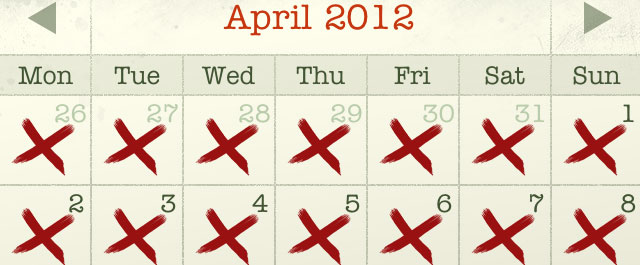
    If you achieve your goal, then put a big coloured cross on that day, so you know that you accomplished what you've set out to do. After a few days of doing this you'll notice a chain of crosses start to build up, and like a snowball, it will build up and up, helping you to cement this practice into your life. 

    Since starting this, I've already noticed a difference in my personal productivity.

    Another thing you'll notice is that as you're chain builds up, you'll desire to keep it going without breaking will remain strong. I'm not saying that there won't be days when you really don't care, but stick at it and you won't regret it. 

    If you do happen to miss a day, don't stress, just get right back to it the next day. I should point out however, that once you miss a day, it can easily cause you to miss another day, then another and so on. So just be persistent


    I don't claim ownership or credit for the picture present, all credit is reserved for the original owner. No copyright intended and I am in no way profiting from  the images present. If you have an issue with the picture that is present, then please contact me.
    Older Post ►
     

    Copyright 2011 Smart Blogging is proudly powered by blogger.com